- Technology
How does the data collected by the GR100 robot help you make operational decisions?
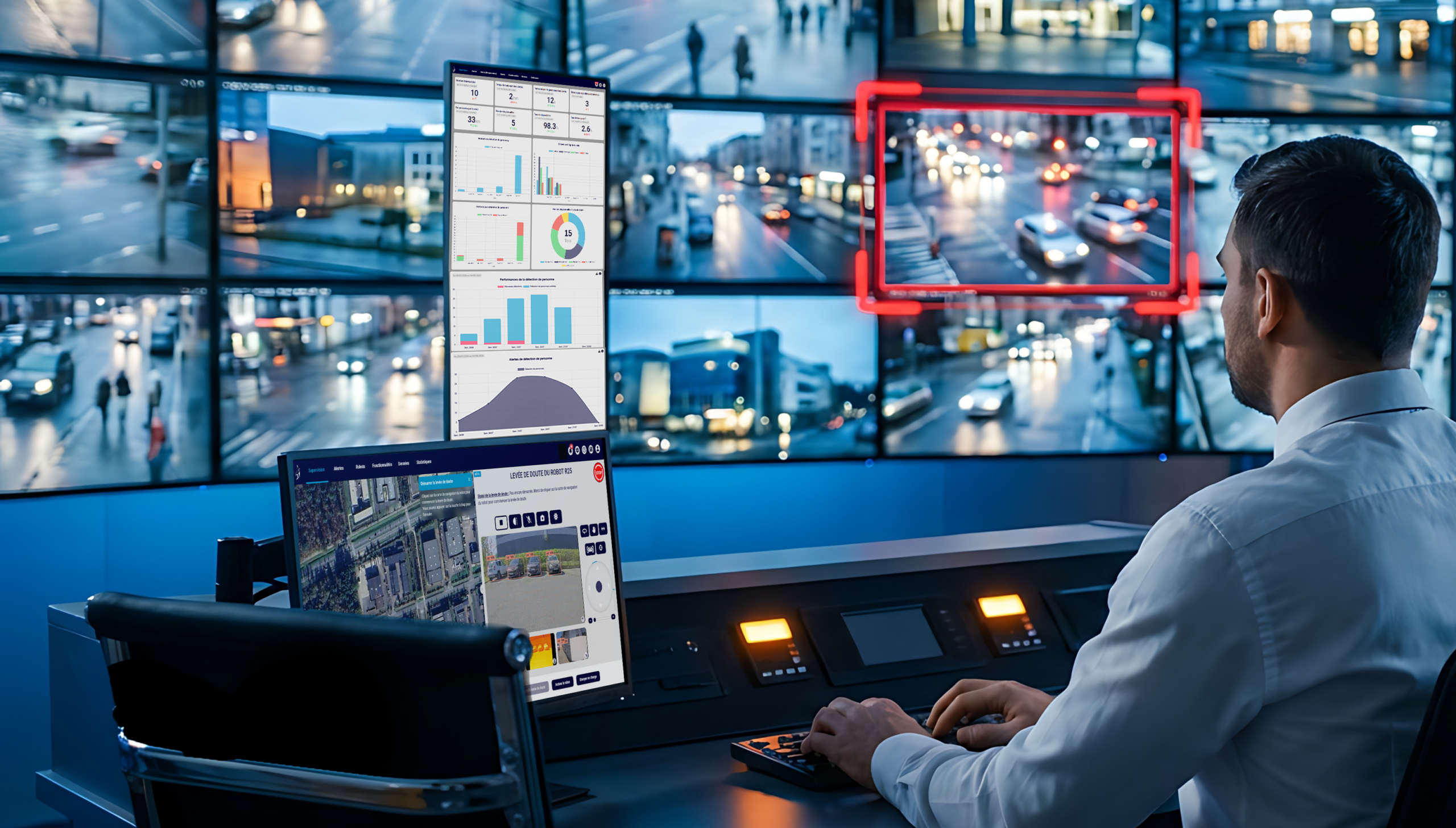
At an industrial or sensitive site, security decisions are based on knowledge of the site, internal procedures and the expertise of professionals. The data collected by the GR100 autonomous security robot provides additional information: detected events, the location of alerts, timings, patrol history, response times, verification of incidents and operational availability. Centralised in the Running Brains Operations Centre (RBOC), this information enables security managers and operators to identify recurring anomalies, prioritise alerts, adapt patrols and measure the impact of corrective action. The GR100 collects and organises field data. Security professionals interpret this data, assess its criticality and decide on the action to be taken.
Private security professionals rarely rely on a single means of surveillance. Their systems generally combine security guards, CCTV cameras, access control, perimeter alarms and various technical sensors.
The challenge lies in utilising the information generated by these systems to answer specific questions: does an alert require immediate action? Should a particular area be patrolled more frequently? Is an anomaly a one-off or a recurring issue? Has a corrective measure produced the expected result?
By carrying out autonomous patrols according to a defined protocol, the GR100 robot provides regular, time-stamped and geolocated data. The value of this data lies not only in the detection of an event, but above all in the ability to compare patrols over time, measure the system’s activity and link an alert to an operational decision.
1. Moving from a single observation to a usable history
An on-site observation provides useful information at a specific point in time. To make an informed decision, the security manager must also know whether the incident has occurred before, how often, and under what circumstances.
The data collected during GR100 patrols helps to build up this historical record. In particular, it can provide details of the area concerned, the time of detection, the type of anomaly, the patrol during which it was observed, the available images, the time taken to transmit the alert and the action taken by the operator.
This continuity makes it easier to distinguish between an isolated incident and a recurring phenomenon.
A door left open on a single occasion requires immediate verification and action. Several similar alerts, observed in the same location and within the same time frame, may indicate a problem with procedures, organisation or equipment.
Field data therefore enables us to move beyond treating alerts on a case-by-case basis. It provides the security manager with the information needed to adjust the security arrangements over the long term.
Indicators directly linked to operational decisions
Not all indicators serve the same purpose. Their usefulness depends on the decision to be made.
Data tracked
What it enables you to analyse
Possible operational decision
Alerts by area and time slot
Identify recurring patterns and sensitive periods
Change patrol timetables or routes
Time taken to generate an alert
Measuring the transmission rate after detection
Check the information flow
Time taken to process an alert
Assess the time between arrival and admission
Adjust escalation procedures or the resources deployed
Number of verification checks carried out
Identify the areas that require regular checks
Step up monitoring or amend the protocol
False positive rate
Assessing the relevance of detections
Adjusting parameters or algorithms
Number of patrols and kilometres covered by the robot
Measuring the site’s actual coverage
Rebalancing patrols and frequencies
Availability rate of the GR100 robot
Monitor the device’s actual ability to carry out its autonomous patrols
Adapting the organisation and the continuity plan
Site integrity alerts
Keep an eye on doors, gates, barriers or fences
Take technical, organisational or personnel action
This data provides a common basis for operators, site managers and safety departments. It also facilitates the sharing of lessons learnt and reporting to line management.
2. Centralise alerts in the RBOC to facilitate arbitration
Field data becomes actionable when it is accessible alongside its context. The RBOC, a monitoring interface linked to the GR100 patrol robot, centralises patrols, alerts and the information required to assess them.
In particular, the operator can use it to view the robot’s position, the patrols carried out, the location and timestamp of an event, the history of autonomous patrols, operational statistics, live camera feeds and the status of alert processing.
This centralisation ensures that events are not separated from their chronological context. The operator has the information needed to understand what happened before selecting the appropriate response.
Prioritise alerts according to their context
The volume of alerts alone is not sufficient to assess the level of risk. An informed decision must also take into account the area concerned, the time of day, the type of facility located nearby, the frequency of the event, the applicable procedures and information from other security systems.
A presence detected near a sensitive storage area will not be treated in the same way as movement observed in an authorised area during operating hours.
The RBOC provides contextual information. The operator cross-references this with site procedures and their knowledge of the environment.
Measuring the impact of decisions taken
Historical data also makes it possible to check whether a corrective action is having the desired effect.
Let’s take the case of a secondary access point that triggers several alerts between 4 am and 5 am. The security manager can analyse previous events, review the associated footage, add a GR100 patrol to that time slot, alter the patrol route or arrange for a verification visit to the area in question.
They can then compare the situation before and after this adjustment: changes in the number of alerts, response times, the frequency of verification checks, or the deployment of security staff.
Decisions are no longer based solely on on-site observations. They can be monitored and evaluated using observable indicators.
3. Adapt the GR100 rounds to the evolution of the site
An industrial site evolves in line with its operations. Workflows change, new equipment is installed, certain areas become more sensitive, and periods requiring heightened vigilance may shift.
The patrol plan must keep pace with these changes.
During deployment, the GR100’s autonomous patrols are configured according to the site’s operational constraints: sectors to be monitored, restricted areas, traffic rules, speed limits, checkpoints, patrol schedules, points of interest (POIs), TOIs and scenarios for resolving uncertainties.
Operational logs are then used to refine these settings.
Adjusting patrol routes based on observed patterns
The data may show that a particular area generates more alerts at certain times, that a checkpoint regularly requires operators’ attention, or that a section of the route provides little useful information.
The security manager can then relocate a checkpoint, adjust the frequency of checks, increase patrols at a specific time, set up a dedicated patrol, or adapt the procedures for resolving uncertainties.
Depending on the environment, the robot can also be fitted with specific sensors, for example to monitor temperatures or detect certain gases such as HCl, H₂S or CH₄. The integration must be assessed in light of the risk, measurement conditions and site procedures.
Organising an operational improvement cycle
Data exploitation can be organised around a simple cycle:
Observe → qualify → decide → adjust → measure
This method provides a framework for follow-up meetings. It enables each change to the system to be linked to an identified problem and an expected outcome.
To remain useful, the dashboard must focus on a few metrics directly linked to the website’s objectives. An overload of statistics unrelated to the decisions to be made complicates the analysis. A limited number of KPIs, monitored regularly, makes it easier to prioritise.
4. Complement existing safety measures
The GR100 integrates into an existing security structure comprising cameras, access controls, alarms, sensors and manual patrols. Its main benefits lie in its mobility, the regularity of its patrols and the traceability of the data collected.
When an alert is triggered by a fixed system, the robot can travel to the affected area to transmit images and additional information. It thus helps to clarify the situation before a team is potentially dispatched to the site.
It can also check the physical condition of an access point, a fence or a barrier, and then cross-reference this observation with information from access control or CCTV systems.
Security officers retain tasks that require judgement, coordination and the ability to intervene. The robot handles regular, documented patrols in accordance with a defined protocol.
This complementary approach is based on a clear division of roles: the GR100 observes and transmits data, the operator assesses the context and makes decisions, and the security officer intervenes when the situation requires it.
5. Keep the expertise of professionals at the heart of decision-making
The data collected by a security robot improves visibility of site activity, but it is not sufficient on its own to determine the appropriate course of action. An alert must always be interpreted in the light of the criticality level of the area, the activity taking place, the people authorised to be present, internal procedures and the risks associated with any potential intervention.
The operator therefore plays a central role. They cross-reference the information transmitted by the GR100 with that from other security systems, and then assess it against their knowledge of the site. This analysis enables them to classify the incident, select the appropriate escalation level and mobilise the appropriate resources.
Data quality as a prerequisite for arbitration
To fulfil this role, the information must be:
- Precise enough to be understood;
- Time-stamped and geolocated;
- Accessible to authorised persons;
- Stored in accordance with defined rules;
- Protected during transmission and storage;
- Comparable from one period to the next.
These requirements enable professionals to place each event in its context, identify trends or recurring patterns, and measure the effects of corrective action. Protecting access, transmission and storage also contributes to the reliability of the decision-making process, particularly at industrial and sensitive sites.
Monitoring the false positive rate meets this same quality requirement. An irrelevant alert unnecessarily diverts operators’ attention and complicates the prioritisation of events. Analysing such alerts enables detection parameters to be adjusted and the reliability of the reported information to be progressively improved.
The GR100 thus provides regular, mobile and traceable field data, whilst the RBOC structures this data to facilitate its analysis. The decision ultimately rests with security professionals, who determine the scope of the incident and the action to be taken.
For a security manager, the data collected must enable them to answer three key questions: what is actually happening on the ground, what action needs to be taken, and will this action bring about a lasting improvement to the security arrangements?
By providing factual information at each of these stages, GR100 helps teams to prioritise, adapt patrols and document their decisions, whilst keeping their expertise at the heart of operational decision-making.
Conclusion
The value of the data collected by the GR100 robot lies in its ability to link an on-site observation to a concrete decision. A time-stamped, geolocated alert, placed within its historical context, allows for a better assessment of its significance than a signal processed in isolation.
By centralising patrols, alerts, verification checks and operators’ actions, the RBOC provides private security teams with a shared working platform. Managers can identify recurring patterns, adjust patrol routes, modify patrol schedules and measure the results of the actions taken.
This use of data also enhances the synergy between the robot, CCTV, access control, alarms and teams on the ground. Each system contributes part of the information required for risk analysis.
The GR100 robot ensures mobile, regular and traceable data collection. Security professionals cross-reference this information against procedures, site constraints and their operational experience. It is this integration of field data and human expertise that enables better-informed decisions to be made and the security system to be adapted to the site’s actual developments.
Editorial intern at Running Brains Robotics