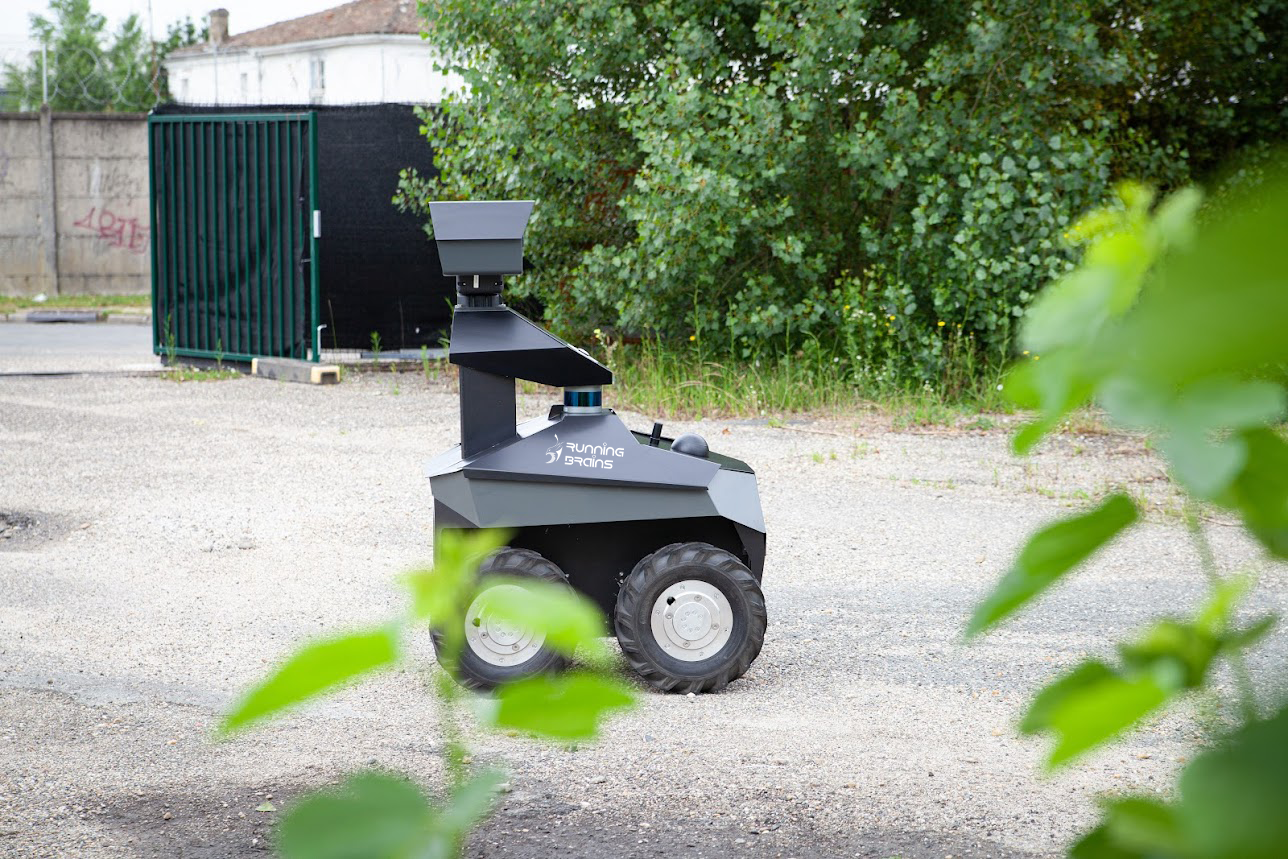
The GR100 is our autonomous ground surveillance solution for sensitive sites. Designed and manufactured in France, it addresses today’s challenges regarding technological sovereignty, continuous surveillance and operational integration. For military bases, it enables a stronger presence on the ground, helps organise surveillance patrols and improves information reporting, whilst ensuring that security teams retain the full availability required for their priority missions.
The surveillance of a military base is part of a strategy aimed at the continuous protection of sensitive sites, access control, the early detection of anomalies, and the effective allocation of human resources. This is taking place against a backdrop of heightened strategic tensions, in which France is reaffirming the need for strategic autonomy and a sovereign, resilient industrial base. The issue is no longer simply a matter of having high-performance tools, but of relying on reliable and proven technologies.
This is where the GR100 surveillance drone provides a concrete solution to a clearly identified need: to strengthen surveillance of sensitive areas through an autonomous ground-based solution, designed for real-world safety and security applications.
Contrary to popular belief, its use is not limited to civilian applications, but naturally extends to demanding environments such as military bases, particularly when it comes to automating repetitive patrol tasks, improving the continuity of surveillance and ensuring the reliability of field intelligence reporting.
Its relevance rests on three essential pillars: technological sovereignty, dual civil-military use, and operational integration capability.
Military bases present significant operational challenges: extensive sites, sensitive technical areas, traffic flows to monitor, access points to control, patrols to carry out, traceability requirements and the need to maintain a high level of vigilance over the long term.
Added to this is an operational reality: teams on the ground are already deployed on numerous missions. Access controls, coordination, supervision, handling alerts, targeted checks and the implementation of procedures all require time and a high level of availability. The continuity of on-site surveillance is a key challenge, and this necessitates the implementation of strategic tools.
At the same time, recent government initiatives in defence, resilience and the security industries all converge on this point: robust, sovereign and interoperable solutions are needed, capable of delivering operational and human benefits.
This is precisely where a solution such as the GR100 patrol robot comes into its own. It takes over the continuity of certain routine, low-value-added missions, improves perimeter coverage, traceability and the ability to resolve uncertainties, whilst leaving teams in full control of decisions, procedures and security actions.
The GR100 security drone has been designed to carry out autonomous outdoor patrols, day and night, and to assist with facility surveillance and perimeter security. Its key advantage lies in its ability to perform regular patrols in a stable, documented and supervised manner.
In an environment such as a military base, this approach offers several concrete benefits:
One of the key strengths of the GR100 ground surveillance drone lies in its dual-purpose nature. The solution already meets specific needs in the civilian sector, at Seveso-class industrial sites, data centres, and energy, chemical, nuclear and storage facilities, as well as at airports, where the requirements for surveillance, continuous monitoring and the protection of infrastructure are extremely high.
This similarity in use reinforces the robot’s suitability for military environments. Although the contexts differ, the requirements are largely the same: external surveillance, continuous vigilance, monitoring of sensitive sites and the need for a regular on-site presence.
From this perspective, the GR100 robot stands out as a coherent solution for sensitive infrastructure in the broadest sense, with a clear positioning in both the civilian and military sectors.
This duality is significant in the current French landscape. The DTIB brings together companies that contribute to the design and production of equipment for the armed forces, under the leadership of the DGA. In parallel, the security industry sector comprises players capable of meeting the protection needs of sensitive infrastructure, territories and organisations. In this context, a French solution for ground-based surveillance robotics, capable of meeting demanding civilian use cases whilst remaining credible for military sites, is part of a convergence between industrial sovereignty, national security and innovation in application.
Whether military or civilian, an organisation facing high-stakes security challenges also assesses the suitability of a solution based on its deployment conditions and constraints. Indeed, a technology is only of value if it can be integrated in a practical manner into an environment already constrained by its procedures, security requirements and business continuity imperatives.
Once again, our complete control of the value chain enables us to overcome the usual barriers to the introduction of robotic technology. The Running Brains Robotics team comprises engineers and technicians who handle the on-site installation of the GR100 robot and its charging station. Furthermore, the robot’s deployment is supported by onboarding and training, whilst the RBOC management interface requires no connection to the client’s information system. For sensitive environments, this approach offers clear benefits: it helps to limit implementation complexity and facilitates the adoption of the solution within a controlled operational framework.
Of course, a military environment imposes its own rules, internal validations and specific requirements regarding cybersecurity and operations. But this approach confirms a clear commitment: to offer a solution tailored to the real constraints of the field.
Furthermore, since 2026, it has also been possible to opt for an on-premises option, allowing the most security-conscious clients to host the solution on a server that is 100% dedicated to them.
In the defence sector, technological sovereignty is just as important as performance. Control over the value chain has direct implications for availability, maintenance, scalability, cybersecurity, supplier dependency and industrial responsiveness.
The State itself emphasises that the DTIB must be supported “in the interests of sovereignty”, and that the security sector must guarantee France’s technological autonomy in critical technologies. An autonomous ground surveillance robot, developed locally and backed by a team capable of upgrading its hardware and software, fits precisely within this framework.
On this point, Running Brains Robotics’ position is clear: we have designed, developed and manufactured the GR100 in France, with 100% in-house control over all technological components, such as mapping, navigation, localisation, detection and measurement algorithms, as well as the electronics, mechanics, assembly and the RBOC* management interface. The GR100 surveillance drone is a robot made in France and primarily equipped with European components. Furthermore, this guarantees the solution’s ongoing scalability.
The GR100 now meets several criteria expected of a French solution with DTIB potential: operational utility at sensitive sites, civil-military duality, technological sovereignty, ease of integration, continuous development and a presence in strategic safety and security markets.
The GR100 meets a specific need: to enhance the surveillance of sensitive sites with a standalone ground-based solution that is intuitive to use and seamlessly integrated. For military bases, its value lies in its ability to carry out regular patrols, maintain external vigilance, improve information reporting, and contribute to a more effective allocation of personnel on the ground.
Designed and manufactured in France, developed for safety and security applications, the GR100 is part of an approach that is operational, sovereign and dual-use, tailored to the needs of sensitive sites facing increasing demands for protection and continuity.

CMO at Running Brains Robotics