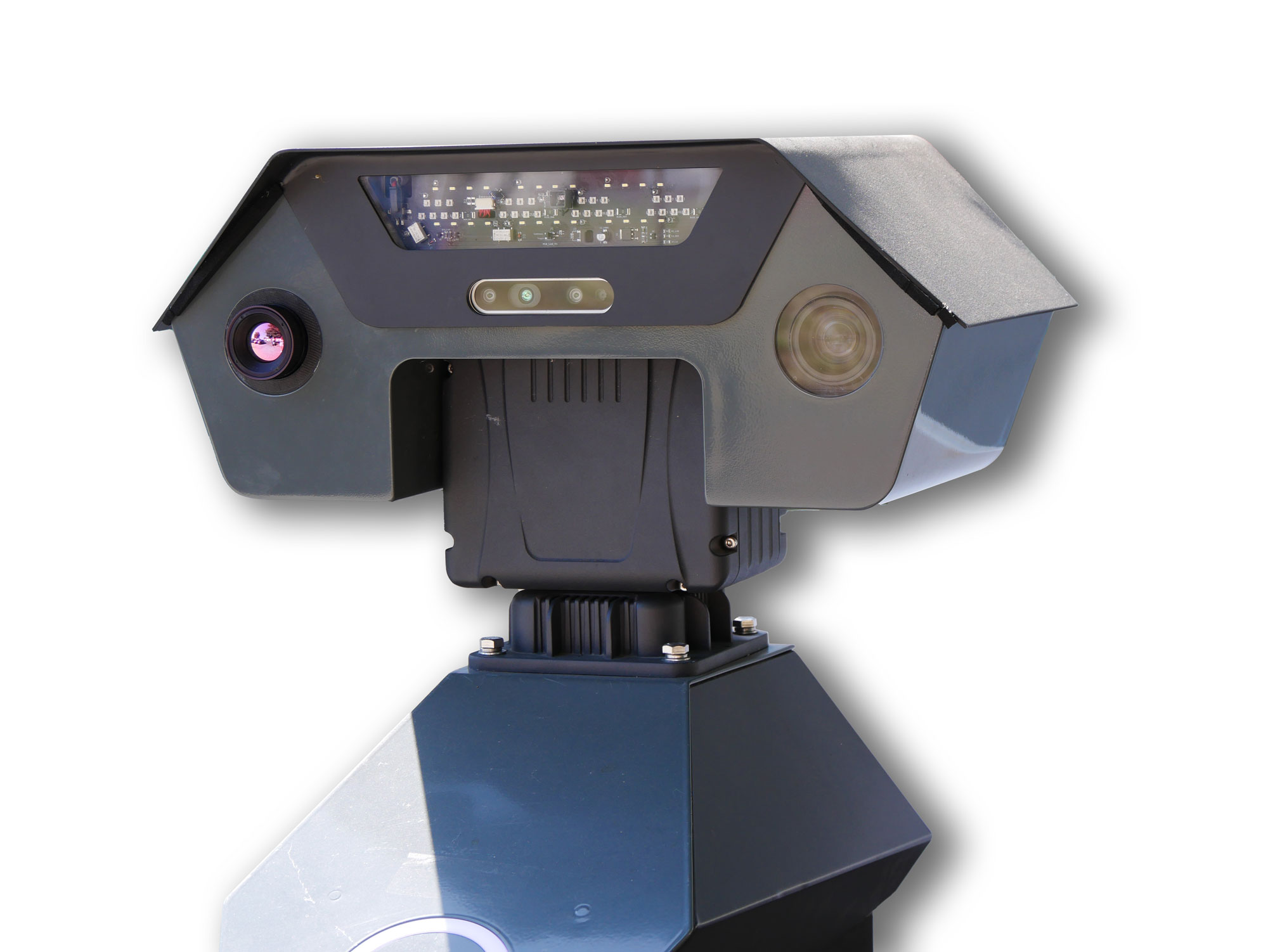
Whether they are industrial sites, water networks or data centres, these sensitive infrastructures all play a key role in the functioning of our communities. As a result, protecting them requires reliable, continuous and adaptable systems capable of dealing with hybrid threats. Whilst security departments face the challenge of better classifying incidents, improving responsiveness and utilising useful field data, security robots such as the GR100 meet these needs through continuous monitoring, incident traceability and reliable, measurable data.
Critical infrastructure performs essential functions on a daily basis: the production of goods, energy and raw materials, as well as storage, transport and so on. The need to secure these systems is constantly growing, given the current geopolitical situation.
Indeed, protecting a critical infrastructure amounts to protecting a service that is essential to a country’s functioning, and this reality places operators on the front line. The protection of these environments must involve continuous, adaptable and controllable surveillance. The priority is to plan, organise and maintain a response capability in the face of multiple risks.
Whether integrated with traditional security systems or used alongside existing teams, autonomous surveillance robots such as the GR100 provide a practical solution to the security requirements of critical infrastructure: reinforcing patrols, adapting to modern threats, assisting in verifying situations, deterring intrusions, detecting anomalies, preventing accidents and supporting security teams over the long term.
Critical infrastructure becomes strategic when it directly supports daily life, economic activity or the stability of a region. A water network, an energy site, a nuclear facility, a logistics hub or a data centre carries a responsibility that extends beyond its technical scope.
This infrastructure enables a state, a local authority or a business to operate over the long term. Its continuity therefore becomes a matter of sovereignty, as it determines a territory’s ability to maintain its essential services, retain public trust and ensure the stability of its activities. Jean-Valéry Lettermann, Director of COSSEN, sums it up clearly: “Infrastructures are interconnected, and our country’s sovereignty depends on these infrastructures ”. For operators, this continuity also affects operational performance, the site’s reputation and the quality of the service provided.
This reality on the ground places multiple demands on security services: maintaining a high level of vigilance to ensure the continuity of service and/or production.
This requires particular vigilance regarding:
Safety and security are at the heart of operational performance and form part of an operational strategy that requires a clear understanding of risks, carefully managed investment, and appropriate human and technological resources.
This strategy encompasses the entire chain: security departments, field teams, security contractors, HSE managers, industrial departments, IT departments, local authorities and institutional partners. The protection of sensitive infrastructure is becoming a collective effort, organised around a single objective: to ensure business continuity.
The risks facing critical infrastructure are evolving and becoming increasingly complex.
They now encompass several dimensions: intrusion, sabotage, cyberattacks, damage to a company’s reputation, disinformation, organisational disruption, industrial espionage (drones), and the exploitation of existing vulnerabilities.
This hybrid nature is changing the way we approach security. An on-site incident can have digital and media repercussions. A cyber incident can slow down the physical operations of a site. A poorly qualified alert can create confusion and slow down decision-making. For Jean-Valéry Lettermann, the new challenges facing these infrastructures relate in particular to drones and cyber threats, two threats that significantly expand the traditional scope of security.
Organisations must therefore rely on a solution capable of linking several levels: continuous on-site monitoring, real-time information reporting, data supervision, anomaly detection and ensuring staff safety…
Modern security relies on this ability to cross-reference signals. It requires a clear view of the situation on the ground, reliable information and tools suited to the unexpected. The aim is to detect threats earlier, assess them more quickly and initiate the right response at the right time. This is where autonomous patrol robots stand out and complement operational security systems.
Critical infrastructure requires integrated safety and security measures right from the project design stage. Olivier King, Head of Safety and Security at Suez, points out that “from the very outset of every project, we must consider safety, security and cybersecurity”. The concept of security by design must be adhered to throughout the entire process – from the development of the security strategy to its implementation, including the integration of new systems such as autonomous robots.
This method brings consistency to the entire system. It enables the creation of an organisation that is transparent, fluid, scalable and adapted to the realities on the ground, by combining the right human, technological and operational resources from the outset.
This approach aligns with the analysis provided by Jérôme Laplace, CEO of Running Brains Robotics, who points out that the security of sensitive sites does not rely solely on the presence of a robot: « When a robot patrols continuously at a hydrocarbon depot, around a data centre, near a military base or at a chemical site, it collects critical data. The algorithms that process it, the servers that host it, the sensors that acquire it: all of this directly determines a country’s ability to protect its own facilities. »
It is exactly the same when it comes to the design of our surveillance robots: data is encrypted, actions carried out within the RBOC are logged, and access to the interface is secure. The ‘security by design’ approach also involves data hosting in France, an annual audit conducted by an external French body certified to ANSI standards, and ISO 27001 certification currently in progress. The core of the system, in other words, our algorithms and AI are developed in-house and designed for private security, with strict compliance with the GDPR and data encryption.
Ultimately, our robots are designed to meet the highest standards of the most sensitive sites (nuclear, data centres, military, etc.) in terms of hardware, software and business functionality.
A critical site requires more than just innovative technology. It needs a reliable, well-managed solution capable of adapting to its specific constraints: sensitive areas, business continuity, internal procedures, cyber security requirements, access management and data sovereignty. The GR100 meets these challenges. Several of our security robots have, in fact, been operational since 2021 at sensitive sites, particularly in defence-related environments. This real-world experience enables us to design deployments tailored to the needs of a variety of sites. Depending on the site’s specific requirements, specific deployment options can also be considered, such as an on-premise architecture or the addition of features like a flashing light, for example.
For critical sites, the GR100 therefore provides an operational solution: an autonomous system, designed to integrate with the existing organisation, enhance team responsiveness and provide reliable information. As Olivier King points out, it is essential to be able to rely on « a comprehensive system capable of responding to the unpredictable ». This is precisely our objective: to offer a robot tailored to the real constraints of sensitive sites, whilst taking into account data, cybersecurity and business continuity requirements.
Critical infrastructure requires security measures capable of evolving in line with emerging risks. It plays a vital role in ensuring the continuity of essential services. The solution rests on three key pillars: anticipating scenarios, protecting critical points, and managing security using reliable data. By integrating solutions such as the GR100 autonomous security robot, security departments can establish more continuous, reliable and measurable surveillance. The robot provides greater continuity and precision in the protection of sensitive sites. For industrial, energy, logistics or strategic sites, security then becomes a driver of resilience.
Sources: AN Sécurité n°1292 – Les infrastructures critiques deviennent-elles des cibles ? [Info à chaud]

CMO at Running Brains Robotics
Editorial intern at Running Brains Robotics