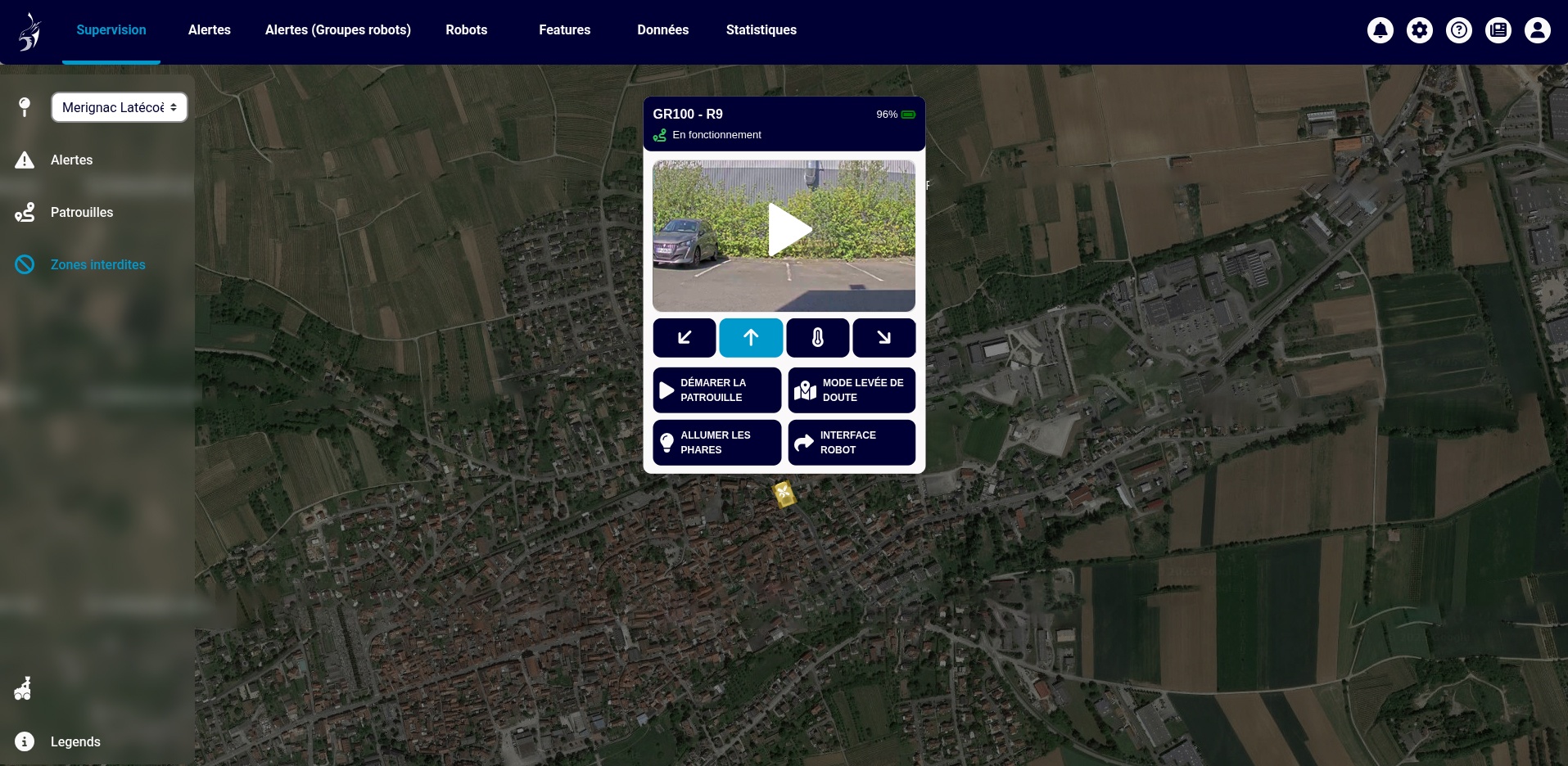
The GR100 security robot combines artificial intelligence, deep learning and navigation and detection algorithms to carry out autonomous patrols and monitor the perimeter areas of industrial, strategic, military and critical sites. It detects and classifies incidents, then sends contextualised alerts to operators to speed up the resolution of incidents and improve decision-making in private security.
Artificial intelligence applied to private security is often reduced to the automatic detection of a person or a vehicle. However, this function represents only part of the tasks carried out by an autonomous surveillance robot.
Before it can detect an event, the robot must map its environment, determine its position, calculate a route, detect obstacles and adapt its movements to changes encountered on site. It must then collect data, analyse it, be trained to avoid false positives and, finally, transmit the data.
These functions rely on various technologies.
Navigation algorithms enable the robot to determine its location and move around. Perception and detection algorithms process the data from its sensors. Artificial intelligence helps to interpret some of this data. Deep learning, a branch of machine learning, enables models to be trained to recognise visual features based on annotated examples.
On the GR100 security robot, this technical chain relies primarily on RB-Nav for autonomous navigation, RB-Sens for perception and detection, and RBOC for relaying information to security teams.
Not all processes carried out by an autonomous robot fall within the scope of artificial intelligence.
An algorithm is a sequence of operations designed to solve a specific task. In a security robot, algorithms can be used to estimate a position, fuse data from multiple sensors, calculate a trajectory, filter an image or determine whether an obstacle is in the path.
Artificial intelligence encompasses methods that enable a system to analyse data and extract useful information from it. In the context of private security, it can help to recognise a person, a vehicle, an object or a hole in a fence, for example.
Deep learning is based on deep neural networks trained using data. For computer vision applications, these models learn to identify features in images in order to perform various types of tasks.
In particular, they are used to:
They enable you to:
They provide additional interpretative capacity for:
Our outdoor mobile robots use deep neural networks designed and trained in-house. Data and feedback from different sites are then used to refine the software and models. The technology integrated into Running Brains Robotics’ robots enables: precise localisation, stable navigation, a high detection rate, a steady reduction in the false positive rate, and ensures the quality of the alerts transmitted.
RB-Nav is the autonomous navigation software developed by our Running Brains Robotics team to control the movements of the GR100 patrol robot.
It combines the processing required for four main functions:
SLAM, which stands for Simultaneous Localisation and Mapping, refers to a set of methods that enable a robot to build a representation of its environment whilst estimating its own position.
Mapping and localisation are closely linked. To determine its position, the robot compares the information provided by its sensors with the landmarks recorded on the map. To build or update this representation, it must have a sufficiently reliable estimate of its position.
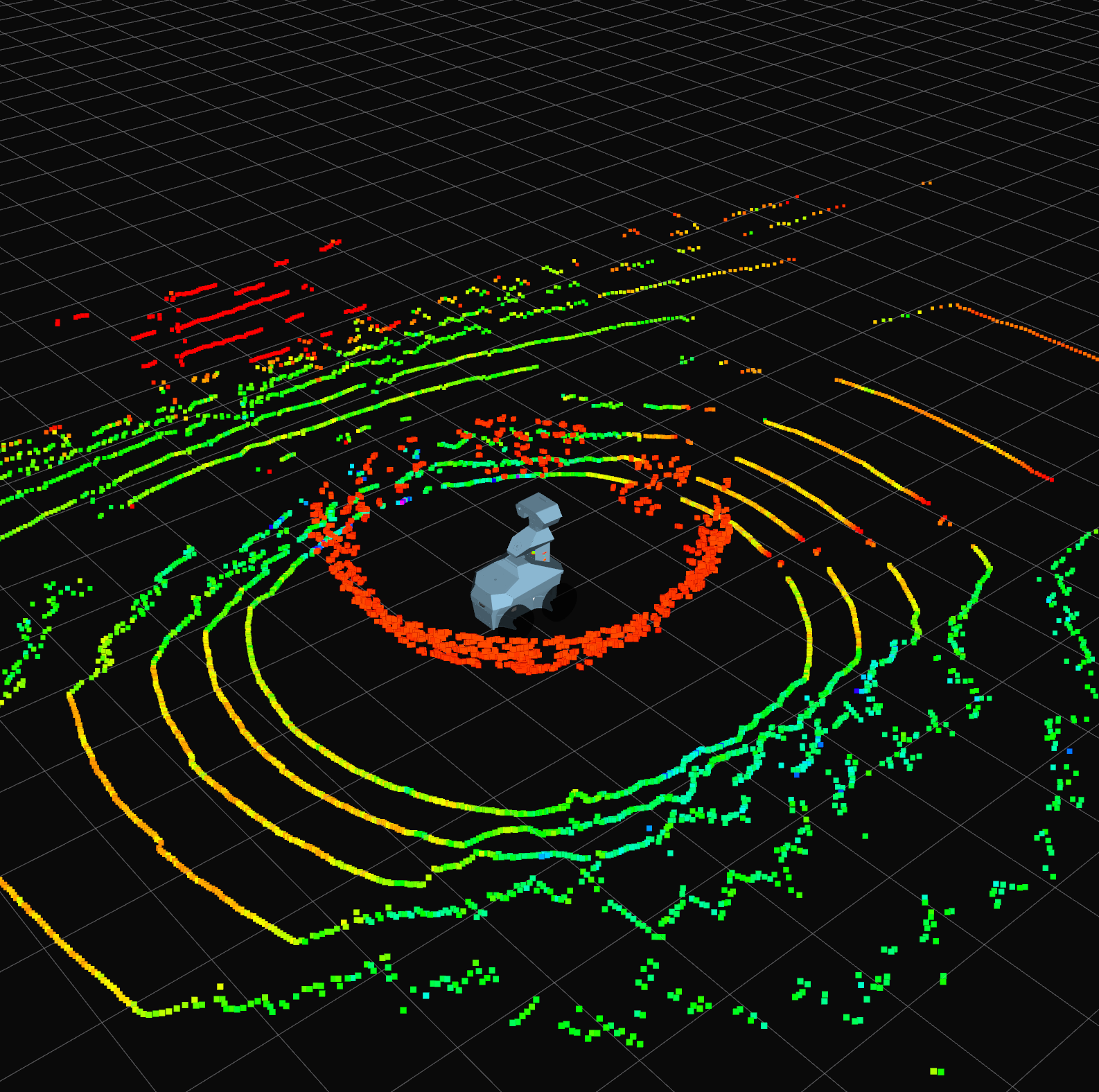
The GR100 uses a 3D map of its environment. It searches for known landmarks on this map to determine its position in real time, even when the environment contains people, vehicles or temporary obstacles.
RB-Nav draws on several sources of information, including:
Data fusion involves cross-referencing these measurements to produce a more consistent estimate of the GR100’s position and its surroundings. The robot’s autonomous navigation relies in particular on a combination of data from the 3D LiDAR, GPS, cameras and the inertial navigation system.
Once its position has been estimated, the GR100 calculates a route between its current position and the next waypoint in its mission.
The route planning takes the following factors into account, amongst others:
The robot therefore does not simply follow a pre-programmed path. RB-Nav constantly compares the calculated trajectory with the data fed back by its sensors.
When an obstacle appears, the system adjusts its movement according to the situation: slowing down, stopping or searching for an alternative route to enable the mission to continue.
To ensure safe navigation, RB-Nav updates the GR100’s trajectory using perception data collected in real time.
The robot can therefore detect and avoid moving obstacles, such as a person or a vehicle, as well as static or temporary obstacles that have appeared since the map was created.
It also recognises restricted areas, whether permanent or temporarily designated, as well as areas where it must reduce its speed. This perception of the environment enables the robot to behave in a consistent and safe manner.
A temporary restricted area may, for example, be defined when part of the site becomes temporarily inaccessible due to construction work, maintenance operations, temporary storage or an ongoing intervention.
This area is marked out in the RBOC and incorporated into the navigation calculations. The GR100 then plans its route without entering the affected sector.
The navigation parameters are defined during the robot’s integration phase, in consultation with the safety managers and the operators concerned.
This work makes it possible, in particular, to identify:
The quality of autonomous navigation therefore depends both on the technical performance of RB-Nav and on the accuracy of the configuration carried out in accordance with the site’s constraints and procedures.
RB-Sens is the perception and detection software developed to analyse the data collected by the GR100.
It combines image processing algorithms, classification rules and deep learning models to transform the robot’s observations into events that can be utilised by security teams.
Detection involves searching through data for the presence of an element that matches a defined scenario.
Depending on the mission and the equipment deployed, this search may focus on:
The detection must then be placed in its operational context in order to be of use to security staff. It can be linked to the area in which the alerts are triggered, the relevant inspection zone, the date and time, and the patrol currently underway.
Classification involves assigning a category to the analysed object.
A model can, for example, distinguish between a person, a vehicle or another object corresponding to the categories on which it has been trained.
This process adds semantic context to the detection. For an operator, an alert indicating the presence of a person in a specific area is more directly actionable than a simple notification of movement.
The result must, however, be assessed in the context of the site and the scenario parameters: the area concerned, the time of day, the model’s confidence level, or the conditions under which the alert is triggered.
Object detection can provide the approximate position of an element within an image, usually in the form of a bounding box.
Segmentation carries out a more detailed analysis. It assigns a category to the pixels in the image in order to precisely delineate a shape, an object or an area. This precision can help to determine:
Segmentation therefore helps to provide the operator with a more accurate representation of the scene.
A deep learning model is trained using a dataset that is representative of the items it is required to recognise.
Its performance depends, in particular, on:
The model generally produces a prediction accompanied by a confidence score. This result can then be filtered and compared with the rules defined for the monitoring scenario.
The output of a deep learning model is not necessarily transmitted directly in the form of an alert.
It may be associated with:
A person detected in an authorised area during normal operating hours does not carry the same significance as a person detected in a restricted area outside scheduled hours.
Assessment therefore involves comparing the technical result with the operational context.
In private security, a system’s performance is not measured solely by the number of events detected.
A system that is too sensitive can generate a large number of false positives. These alerts, which have no operational value, increase the processing load and risk distracting operators.
Conversely, thresholds that are too restrictive can reduce the system’s ability to detect the events it is designed to detect.
The configuration of models, filters and thresholds therefore aims to strike a balance between two objectives:
A useful alert should enable the operator to quickly understand what has been detected, where the event occurred, when it took place and why it triggered a notification.
In particular, the GR100 can transmit alerts relating to the detection of a person, the absence of a padlock, a temperature threshold being exceeded or an abnormal gas concentration. Qualified events are then forwarded to the RBOC so that they can be reviewed and dealt with by the security teams.
Alerts are supplemented with detection images, videos and the location of the alert to help the operator understand the context of the situation and dispatch the robot to investigate further.
The capabilities of our autonomous surveillance robots are based on a comprehensive technology stack that combines algorithms for navigation, perception, artificial intelligence and deep learning. RB-Nav enables the robot to determine its location, plan its trajectories and adapt its movements. RB-Sens combines perception algorithms and AI models to analyse data from cameras and sensors, in order to detect, classify and categorise events before they are fed into the RBOC.
The benefit of this architecture is that it transforms data collected in the field into information that can be directly utilised by security teams. The more the algorithms, AI models, detection thresholds and scenarios are trained, the more accurate they become and the better they are tailored to the site’s constraints; consequently, alerts become more relevant and precise.
For us, this control over the technological chain (hardware and software) is a matter of sovereignty. This control enables us to adapt the robot’s performance as closely as possible to the realities on the ground: making autonomous patrols more reliable, detecting anomalies more effectively, minimising irrelevant alerts and speeding up the verification process.
For private security professionals, the benefits are tangible: more regular surveillance, higher-quality information and more useful data to guide their decisions and interventions.
*RBOC : Running Brains Operations Center.

CMO at Running Brains Robotics
Editorial intern at Running Brains Robotics